Relationships Are Where We Live

July 30, 2026
Kyle on panel cropped
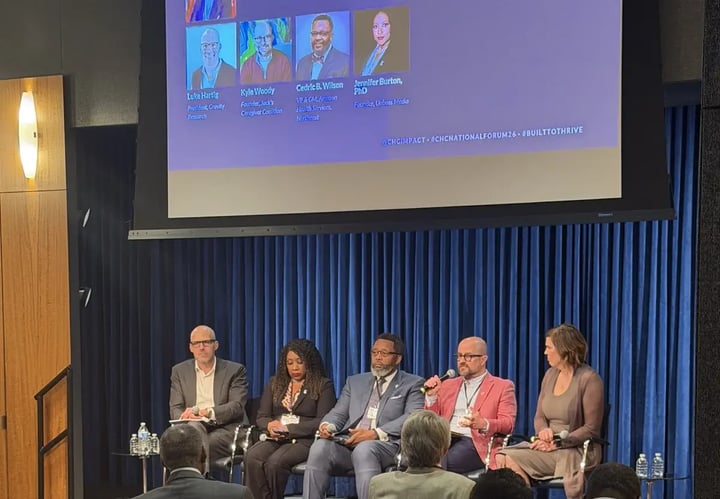
Kyle Woody speaking on panel at the CHC National Forum on : ‘The Business Case for Healthy Communities: Why Where Your Employees Live Is Your Business.'

Reflections from the CHC National Forum

By Kyle Woody

Last week, I traveled to Washington D.C. to contribute to a panel discussion at the CHC National Forum titled “The Business Case for Healthy Communities: Why Where Your Employees Live Is Your Business,” moderated by Alison Braman, SVP of HR at Hilti North America. It was an invitation only event full of people redesigning the future of health, longevity, and community.

People like Jean Accius, the CHC President and CEO, the visionary behind CHC's moonshot to cut the life expectancy gap in half in this country in a decade, the chair of the Jack's board, and the reason Oprah told the story of Jack's.

As someone who helps people find themselves and their people, this forum was me finding my people. People from all over the world.

Here's a few ideas I highlighted in my notebook:


Ken Dychtwald: We were not previously a youth oriented society. Not long ago, the longer you lived the more power you had. Today 96% of medical schools require pediatric rotations, while only 10% require geriatric rotations. That statistic stuck with more than almost anything else I heard.

Percil Stanford: Percil was the first person to greet me when I walked into the forum. When he took the stage I learned he is Jean Accius' mentor. Jean is one my key mentors, so when those two gentle giants took the stage and discussed "intergenerational mentorship", I was deeply moved. Percil explained how effective it is at passing down the will to make a difference in this world. I listened in awe, realizing I am a product of their relationship.

Bina Venkataraman: Hope isn't in the data. It's in the mind, the heart, the imagination of optimistic people.

Rawle Andrews: The average American worker gets between 4.5 - 5 hours of sleep per night. The APAF offers "N.T.A.", a free training that empowers school administrators, coaches, custodial staff, food service staff, mental health staff, nurses, and teachers—with the right tools to make a difference in the mental health of students. 

Beth Murray: It's time to move beyond "lifespan" to "healthspan".  28 orgs have signed onto a definition of it, the four pillars of it are vitality, growth, belonging, and stability. 

Israel Cross: Social isolation is a core product of aging in the United States. 

Rani Snyder: Coordination is amplification. Ageism is not the only important "ism", but it magnifies a lifetime of inequities. 

Sandy Markwood: The power of peers, "Governors listen to Governors."

Rebecca Kaduru: Surviving a crisis isn't what's important, recovery is.

Paxton Baker: Diet is more than the food you ingest, it's also the media you consume. China is not a country of immigrants.

Hill Harper: The number 1 thing people who are incarcerated have in common is that they are poor. The way you make people care is you make them feel. The way you make them feel is through stories. The ill-intentioned people bring MASSIVE amounts of energy, so we have to bring more. The future belongs to those with passion, those who can reason, those with courage. The end of his talk had the room so energized we were ready to run through brick walls.

My message for that room: "Relationships Are Where We Live"

Every employer I know already knows there's a straight line between healthy employees and the health of their business. 

But CHC’s Built to Thrive Report explains there's also a straight line between the health of your employees and the health of the place they call home.

When I say "home", I'm not just talking about their physical address. I'm also talking about their relationships.

Be they romantic, family, friends, or colleagues. Science says it’s quality of these relationships that matters most, not the quantity.

For a caregiver, home might be his relationship with his dad who was just diagnosed with a brain tumor that lives in another state. Or his relationship with his best friend who just came home from combat with severe PTSD.

For a caregiver home is the uncomfortable couch in a hospital room in another state, because that's the only place on earth who offers the treatment his dad needs. A week later home is his kitchen table, covered in medical bills and medication schedules.

Put another way, your employees live where their hearts are. And those hearts walk into your business every day, whether you've built for them or not.

Before founding Jack’s Caregiver Coalition, my entire career had been dedicated to the construction industry. In my last season in that career, I worked as a culture change agent encouraging management teams to empower the crews on their job sites to be far more than meat and bones executing mindless tasks. To be the craftsmen (and women) they all aspired to be, building the best buildings the world has ever seen.

Let’s take a close look at one of those guys.

A typical case: he's paid hourly. He doesn't have the advantages of flexibility and benefits his salaried supervisor does.

Then his wife gets cancer, or his dad's forgetfulness is officially dementia now. Suddenly, he's carrying two identities. The one on his hard hat, and the one nobody at work knows how to talk about.

The people closest to him ask, 'How's your dad?' or 'How's your wife?' But they won't ask, 'How are you?' — because deep down, they know he's not okay. So they talk about sports instead.

Ask that guy if he's a caregiver, he'll shrug. He has no idea what that means. Ask him if he's a provider, his spine will straighten. That's an identity he's proud of. That's the one he sees himself in.

Here's what I hope this room will sit with: what is a caregiver, if not a provider?

Is he failing at being a provider when he stays up all night with his wife after chemo, so she’ll feel a little less alone in this world?

If you ask me, that’s him doing the whole job.

And if he calls in sick the next morning — to his job operating heavy machinery — because he didn't get enough sleep — is that him failing at being a heavy machine operator?

If you ask me, that's him being a great provider. That's him being a great operator. That's him looking out for his crew too.

If you ask me, a man caring for the people he loves shouldn’t cost him his identity.

The business case for healthy communities absolutely means your employees need clean air and grocery stores nearby. But that's table stakes if you ask me.

It's also, how connected do your employees feel to their sense of themselves? How “at home” do they feel when they’re at home? How “at work” do they feel when they’re at work? How strong are their essential relationships?
How I felt when I left

I left that stage more convinced than ever that this idea — caregivers are providers, not a departure from it — is the door that gets men in the trades, in logistics, on the front lines of every industry, to finally see the whole of who they already are.

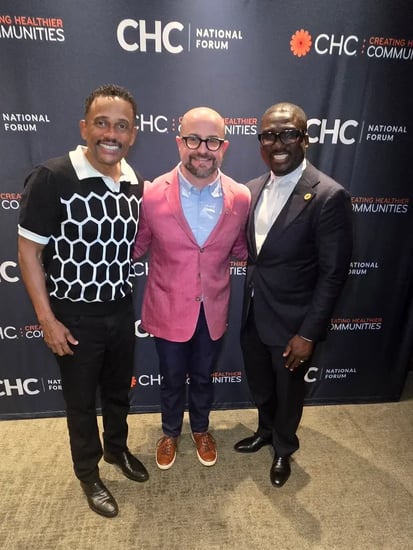
And I left D.C. grateful to feel connected to a brand new community dedicated to cutting our longevity gap in half in a decade. And thanks to Hill Harper I left ready to run through any brick wall put in front of Jack's Caregiver Coalition.

If my message is one your company, conference, or team needs to hear, I'd love to bring it to your stage too.

Book Kyle to speak → jackscaregiverco.org/speaking

Hill Harper, Kyle Woody, & Jean Accius
From Left to right: Hill Harper, Kyle Woody, & Jean Accius
Kyle Woody
Written by Kyle Woody
Kyle was a caregiver to his wife who had metastatic colon cancer for 5 years before she asked him for a divorce. One of the three proud founders of the coalition, he has served as executive director since day one. You’ll often find him swearing at his laptop, rucking in the woods, or sweating like an old fat horse in one of his group exercise classes. He is blessed daily by his children, his chickens, and his boy dog named Janet.